What changes as organizations grow?
We analyzed 9,733 organizations from The Official Board Iconic 10,000, a selection of the world’s most significant companies compiled from 19 leading business rankings.
We expected organizations to become increasingly different as they scaled. Instead, the largest organizations increasingly converge on remarkably similar ways of organizing, leading and investing.
Three recurring questions guided our analysis:
• How is work coordinated?
• What do leadership teams prioritize?
• Where do organizations invest for the future?
Rather than starting with predefined categories, we analyzed executive reporting structures, leadership responsibilities and leadership changes across thousands of organizations. Recurring patterns naturally emerged.
Those recurring patterns were grouped into consistent Operating Models, Leadership Priorities and Investment Priorities. The following sections show how the most common of those patterns evolve as organizations scale.
1. How work is coordinated
As organizations scale, they change how they coordinate work.
Young companies organize around products. Large organizations increasingly organize around execution, consistency and coordination
Four operating models explain almost every large organization we studied.
Product Ecosystems (where many growth companies start)
Examples : OpenAI · Databricks · Canva
Teams are organized around products and customer experiences. Innovation and speed take priority.
Business Lines (as they diversify)
Examples : Toyota · Siemens · Caterpillar
Independent businesses own performance while corporate leadership allocates capital and talent.
Centralized Operations (to improve consistency and efficiency)
Examples : Apple · Ikea · Inditex
Key decisions are coordinated centrally to improve consistency, efficiency and governance.
Regional Operations (to execute effectively at global scale)
Examples: Nestlé · Schneider Electric · Unilever
Regional leaders adapt execution to local markets while following common global standards.
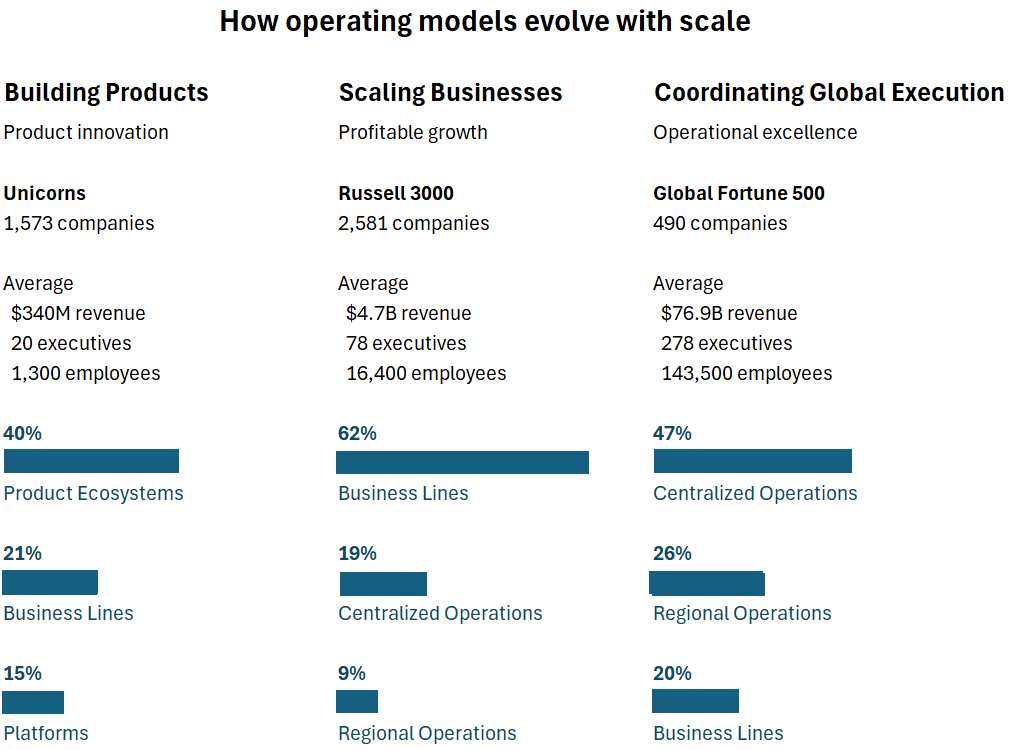
As organizations scale, different operating models become dominant.
The challenge: Align the operating model with the company’s current stage of growth.
2. What leadership teams prioritize
As organizations evolve, leadership priorities evolve too. Scale changes what leadership teams discuss around the executive table.
Financial Discipline becomes increasingly dominant, while Execution and Regional Execution gain importance as organizations reach global scale.
The four dominant leadership priorities
Products (to win customers)
Examples: Meta, Netflix, Salesforce
Leadership focuses on building products customers value. Innovation, differentiation and customer adoption drive decision-making.
Financial Discipline (to fund sustainable growth)
Examples: ExxonMobil, JPMorgan Chase, Costco
Leadership prioritizes capital allocation, profitability and long-term financial resilience.
Execution (to deliver consistently)
Examples: Amazon, Apple, Toyota
The focus shifts from defining strategy to delivering it consistently across the organization.
Regional Execution (to adapt globally)
Examples: Walmart, Nestlé, HSBC
Global priorities remain consistent while regional teams adapt execution to local markets and customers.
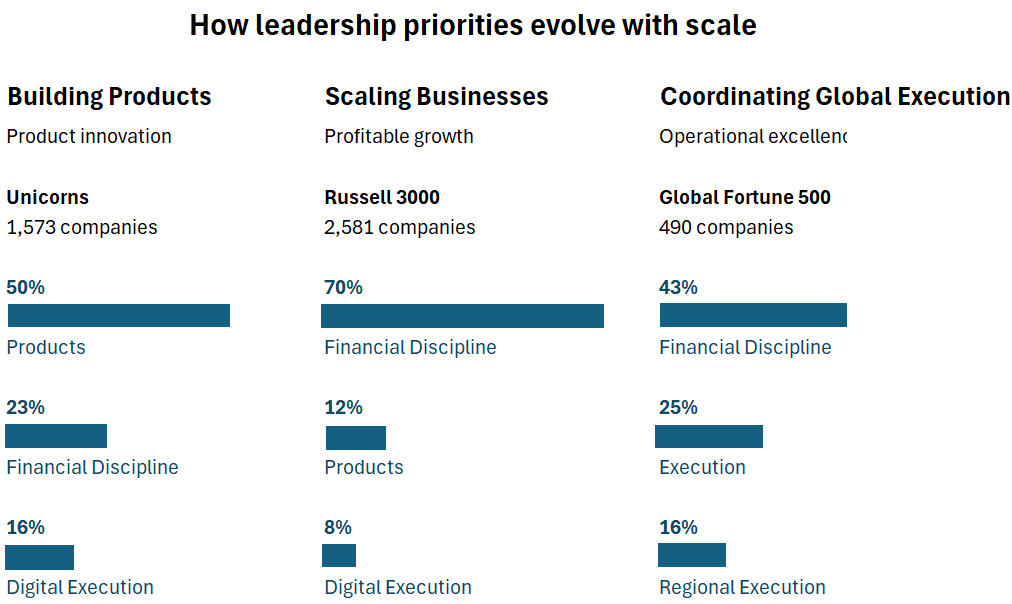
As organizations scale, different leadership priorities become dominant.
The challenge: Ensure leadership attention evolves as quickly as the organization itself.
3. Where organizations invest
Finally, organizations evolve through what they choose to build next.
As companies mature, investment priorities become increasingly concentrated.
• Young companies invest to grow.
• Mid-sized companies invest to scale.
• Large enterprises invest to strengthen resilience and optimize operations
The five dominant investment priorities
Regional Simplification (to reduce complexity)
Examples: Nestlé · Unilever · Danone
Organizations simplify regional structures to improve execution while remaining close to customers.
Electrification (to prepare for the future
Examples: BYD · Siemens Energy · ABB
Companies invest in electrified products and infrastructure to support the long-term energy transition.
Capital Discipline (to maximize returns)
Examples: Berkshire Hathaway · ExxonMobil · Costco
Investment decisions increasingly prioritize returns, cash generation and long-term financial resilience.
Risk Management (to increase resilience)
Examples: JPMorgan Chase · Shell · HSBC
Leadership invests in identifying, monitoring and mitigating operational, financial and geopolitical risks.
Supply Chain Integration (to strengthen operations)
Examples: Walmart · Toyota · Schneider Electric
Organizations invest in tighter coordination across suppliers, manufacturing and distribution to improve resilience, efficiency and customer service.
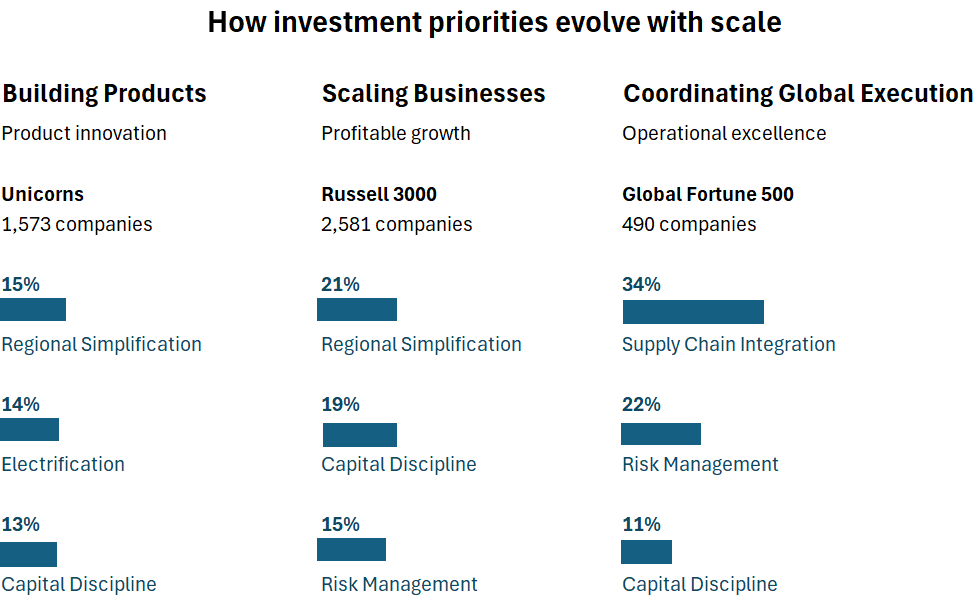
The challenge: Invest ahead of the next stage of scale, not just today’s priorities.
Conclusion
One of the most fascinating findings of this research is that some of today’s largest enterprises have already travelled this path.
Amazon, Microsoft and Alphabet illustrate that evolution. They all began as relatively small organizations. Today they are among the world’s largest enterprises.
Products evolve. Markets evolve. Organizations evolve too.
Organizations don’t simply scale. They evolve in recognizable patterns.
