Org chart movements reveal strategy in motion.
When companies adjust who sits closest to the CEO, they quietly signal a shift in priorities.
To understand this transformation, we analyzed 45,000 companies generating more than $100M in annual revenue, comparing June 2024 and October 2025 org charts. Our focus: how digital, data, and artificial intelligence roles have evolved among executives reporting directly to the CEO (N-1) or one level below (N-2), the layers where strategic direction turns into execution.
1. AI Moves to the Core
In just 16 months, the number of top-level AI roles grew sixfold, and by elevenfold within the Global Fortune 500.
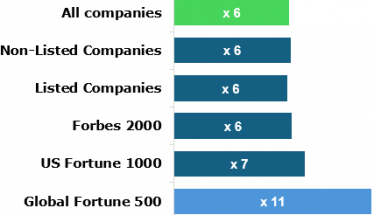
Growth of AI roles (June 2024 → Oct 2025) by company type
The title Chief Artificial Intelligence Officer — almost unseen in 2024 — is now the first truly dedicated AI role at the top of the org chart, with 286 active leaders. It is followed by Chief Data & AI Officer, Head of AI & Data Science, and VP, AI Solutions.
AI has become a regular seat near the CEO, showing it is no longer an experiment but a corporate capability.
In earlier AI waves — Deep Learning (from 2012) and Generative AI (from 2022) — AI remained confined to technical experts. Fewer than 50 AI roles appeared at the top during those periods.
What changed in early 2025 is the rise of agentic AI: networks of specialized AI agents that coordinate and supervise one another, dividing tasks, checking outputs, and escalating exceptions for human judgment. This model is reshaping how large companies organize work, monitor compliance, and ensure performance.
Most projects remain in pilot phase, but momentum and expectations have never been higher.
2. Transformation speeds differ by industry
Manufacturing, Services, and Healthcare are moving fastest—embedding AI leadership into core operations. Finance, consumer, technology, and transportation show slower relative growth, less from resistance than from later adoption curves and regulatory or operational constraints.
Across regions, North America and EMEA are advancing at similar speeds, while APAC is moving forward at a steadier pace.
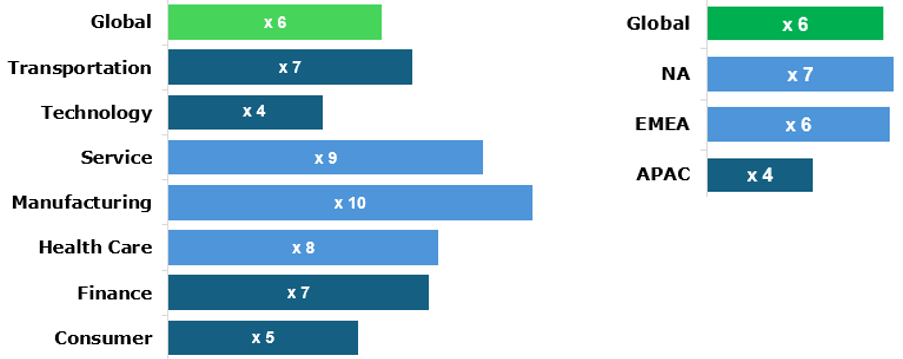
Growth of AI roles (June 2024 → Oct 2025) by sector and by region
Beneath the visible VP of AI, a new layer of functions is emerging:
• AI integrators linking intelligent systems to business outcomes
• AI assessors tracking model accuracy and drift
• AI auditors testing fairness, compliance, and reliability
3. Digital and data still expanding
Data and digital roles remain the foundation on which AI is being built.
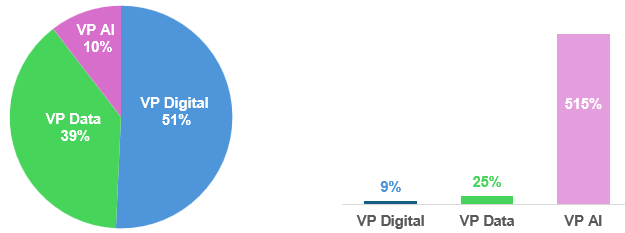
Presence per role (Oct. 2025) Growth by role (June 2024 → Oct. 2025)
Between June 2024 and October 2025:
• Digital roles grew by 9%, consolidating a decade of steady progress
• Data roles rose by 25%, showing greater maturity and scale
Growth remains balanced across Digital Transformation, Digital Marketing, or CIO & Digital roles, and across Data & Analytics, Data Science, or Data Engineering. These disciplines have reached a phase of steady expansion and now form the platform supporting AI’s next stage.
4. Strategic proximity to the CEO
Nearly one third of digital, data, and AI leaders now report directly to the CEO (N-1), a proximity that was rare even for CIOs a decade ago.
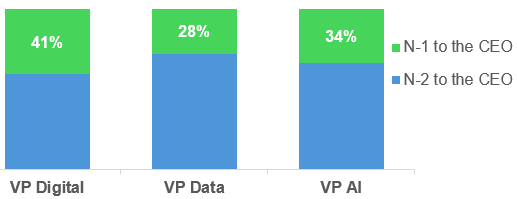
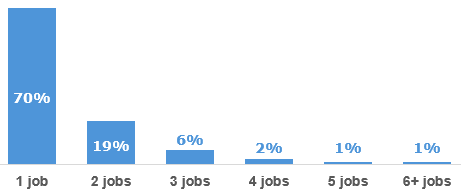
Across the 45,000 companies, about 14,000 executives hold roles in these domains, averaging 1.5 per company. Some organizations — JPMorgan Chase, Bloomberg, Nvidia, and Guardian Life — count eight or more such leaders within their executive committees, reflecting deep digital integration.
Work in progress
Progress remains uneven. AI tools are spreading quickly but integrating them into daily workflows and leadership routines still takes time.
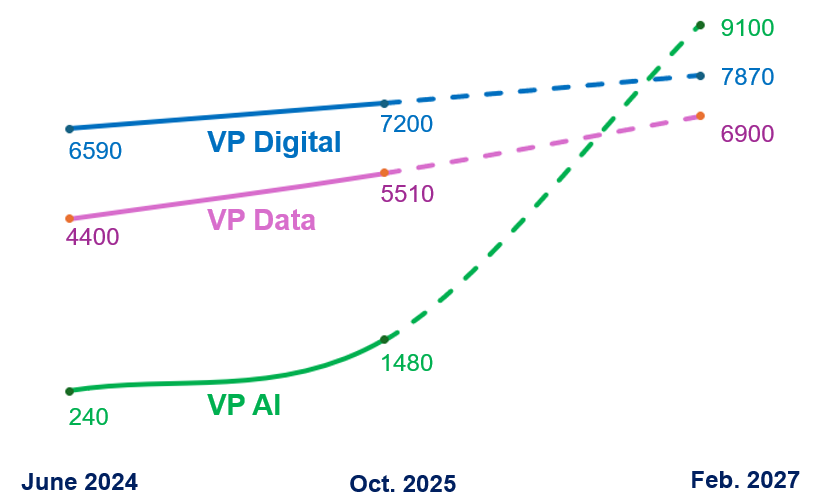
If the current monthly trend continues, by early 2027 more than 9,000 vice presidents of AI could sit on executive committees — slightly exceeding the number of vice presidents of digital. This projection is based on observed monthly growth rates across the 45,000 companies between June 2024 and October 2025.
No one yet knows how far this transformation will go. What is clear is that AI is now part of how companies lead, decide, and organize work.
The coming months will test how leadership teams balance automation with judgment, speed with governance, and innovation with trust.
Change at the top rarely happens overnight — but this one has begun !
Want more? Get fresh monthly insights and tips by email.
