If AI is transforming everything, why do supply chains and risk management appear more often than AI in the organizational priorities of the world’s largest companies?
We analyzed the organizational changes of 1,998 Forbes Global 2000 companies over the last 12 months: executive appointments, promotions, departures, reporting lines and leadership movements. The Forbes Global 2000 includes 1,998 of the world’s largest listed companies.
What emerged was surprisingly simple.
Across dozens of industries and countries, a relatively small number of organizational patterns explain most of how large companies:
• coordinate execution
• set leadership priorities
• pursue transformation
The takeaways
• 10 organizational models explain most Forbes 2000 companies.
• 5 leadership priorities explain most leadership agendas.
• 10 transformation themes explain most transformation programs.
1. Large companies are organized around execution, not innovation
To understand how companies coordinate execution, we classified organizational changes into 42 coordination models.
Yet just 10 explain most Forbes 2000 companies.
The dominant models are:
• Logistics Networks
• Business Lines
• Integrated Energy
Companies as different as Amazon, Walmart, Toyota, JPMorgan Chase, HSBC and Siemens face the same challenge: coordinating complexity at scale.
In practice
• Organizational design reveals where management attention is being invested.
• The challenge for large companies is no longer creating a new business model.
• It is operating increasingly complex systems reliably and efficiently.
2. Control beats growth
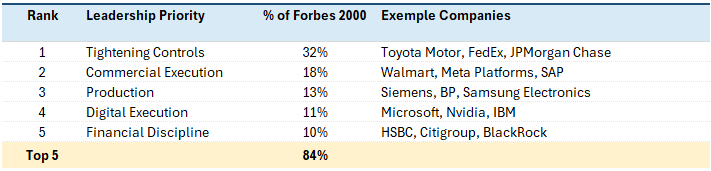
We then analyzed leadership priorities through executive appointments, promotions, reporting relationships and shifts in managerial focus.
Out of 26 leadership priorities, just 5 explain most observed leadership agendas.
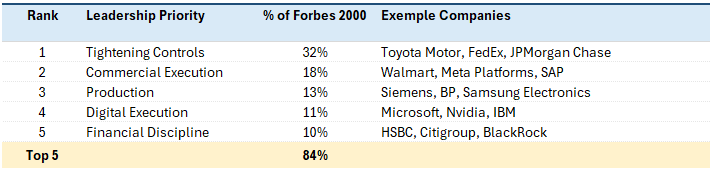
The dominant priorities are:
• Tightening Controls
• Commercial Execution
• Strengthening Production
• Digital Execution
• Financial Discipline
The dominant leadership priority is not growth.
It is execution and control.
In practice
• Leadership structures often reveal future priorities before they appear in earnings calls, annual reports or investor presentations.
• The world’s largest companies are allocating more organizational energy to execution than expansion.
3. Supply chains and risk management matter more than AI
To understand transformation, we classified organizational changes into 26 business transformation themes.
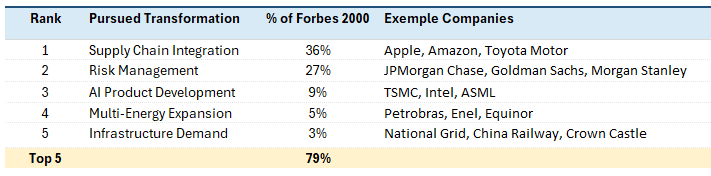
Supply Chain Integration ranks first.
Risk Management ranks second.
AI Product Development ranks third.
Supply Chain Integration is not a sector-specific priority.
It appears in:
• 59% of Consumer companies
• 55% of Transportation companies
• 52% of Health Care companies
• 49% of Manufacturing companies
Even in Technology, Supply Chain Integration (35%) exceeds AI Product Development (11%).
AI is important.
But it is not the dominant transformation priority.
In practice
• Media attention and management attention are not always the same thing.
• The companies creating the most value often invest more in improving execution than pursuing the latest trend.
4. Industry explains behavior better than geography
Industry remains the strongest predictor of organizational behavior.
Finance provides perhaps the clearest example:
• Coordination model: Business Lines (58%)
• Leadership priority: Tightening Controls (48%)
• Pursued transformation: Risk Management (68%)
Consumer companies organize around brands.
Energy companies around integrated operations.
Technology companies around platforms and ecosystems.
Industries continue to develop their own organizational operating systems.
Across all major regions, the dominant themes remain execution, control and risk management.
Regional differences exist, but they are smaller than many expect.
• North America appears to be relatively more AI-oriented.
• Europe leans more heavily toward supply chains and energy transition.
• Asia-Pacific is more focused on risk management and production.
• Latin America shows stronger emphasis on risk and financial discipline.
In practice
• Your most relevant benchmark is often not your geography. It is your industry.
• A bank in Singapore may have more in common organizationally with a bank in New York than with a manufacturer next door.
Conclusion
The real discovery is not AI.
It is concentration.
Organizational complexity looks infinite from the outside.
But underneath, the world’s largest companies repeatedly converge toward the same coordination models, leadership priorities and transformation themes.
Methodology
The analysis is based on reporting lines, executive appointments, promotions, departures and organizational changes observed over the last 12 months across 1,998 Forbes Global 2000 companies.
Approximately 300 organizational indicators were extracted per company as of May 28, 2026. To identify patterns, The Official Board developed a classification framework covering:
• 42 organizational coordination models
• 26 leadership priorities
• 26 business transformation themes
The framework was developed and tested across more than 10,000 medium and large companies worldwide.
Download the exhibit for detailed results, representative companies, industry breakdowns and regional comparisons. Contact us if you would like to explore the methodology in greater detail.
