Viewed in Egon Zehnder
The Chief Supply Chain Officer (CSCO) has evolved from a logistics expert to a corporate strategist, steering companies through a storm of global disruptions, shifting trade policies, and digital transformation.
A recent survey of 68 CSCOs (Egon Zehnder & Imperial College Business School) reveals the key challenges and priorities shaping the role in 2025.
🔹 Cost is King (and a Headache) – 72% of CSCOs cite cost pressure as their biggest challenge, followed by evolving customer demands (46%) and operational inefficiencies (40%). A global footprint and complex org structures only add to the challenge.
🔹 Geopolitics is a Wild Card – With renewed trade tensions and protectionist policies, disruptions are increasing—yet only 15% of CSCOs feel prepared for the impact. Supply chain leaders must build resilient org structures to navigate these uncertainties.
🔹 Tech is a Game-Changer – AI, cybersecurity, and cloud services are transforming supply chains, with blockchain and virtual assistants gaining traction. CSCOs must integrate technology seamlessly to drive efficiency.
🔹 The Leadership Balancing Act – Success depends on leading high-performing teams (56%), crafting clear strategies (50%), and driving efficiency (37%).
🔹 Transformation is the Endgame – 81% of CSCOs are motivated by transformation, not just survival. But they ask for stronger support in digitalization, talent acquisition, and trend forecasting.
The Rise of the Dedicated Chief Supply Chain Officer
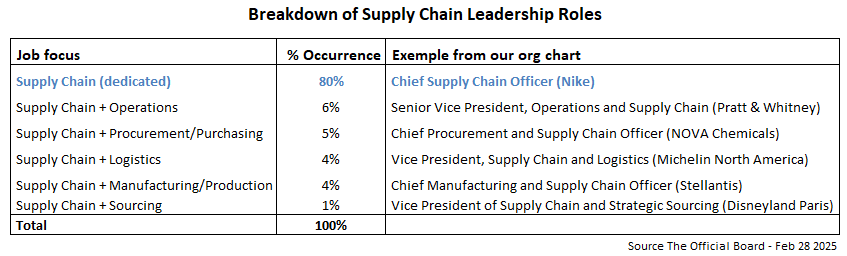
Our 80,000+ org charts reveal that 80% of the 8,000+ CSCOs hold a dedicated supply chain role—a testament to the function’s growing strategic importance. The remaining 20% oversee additional functions, such as operations (6%), procurement (5%), logistics (4%), manufacturing (4%), or sourcing (1%).
🚛 Overhaul
As supply chains grow more complex, companies are recognizing that dedicated leadership, rather than role integration, is key to managing cost pressures, trade disruptions, and digital innovation within evolving org structures.
